Tuesday, October 31, 2017

Arrived

I have made it successfully to McMurdo Station. The entire trip today, from the shuttle pickup at 5:45 AM, to landing at Phoenix Airfield at 2:00 PM, to arriving into McMurdo at 3:00 PM went as scheduled and without any drama. There were 47 passengers on the C-17 military cargo plane for the flight south. The middle of the plane was filled with cargo and shipping containers. At this time of year, any and all goods and materials have to be flown to McMurdo. We left Christurch in about 60F temperatures and we arrived at Phoenix Airfield, outside of McMurdo, with a temperature of approximately 7F.
Dressed in extreme cold weather (ECW) gear and ready to go through the check-in process for the C-17 flight to Antarctica from the Antarctic Passenger Terminal in Christchurch.
On board the C-17 during the 5-hour flight (there was a nice tailwind) from Christchurch, New Zealand to McMurdo Station. Any and everything is done to fill the time. The containers on the right side of the photo are filled with cargo.
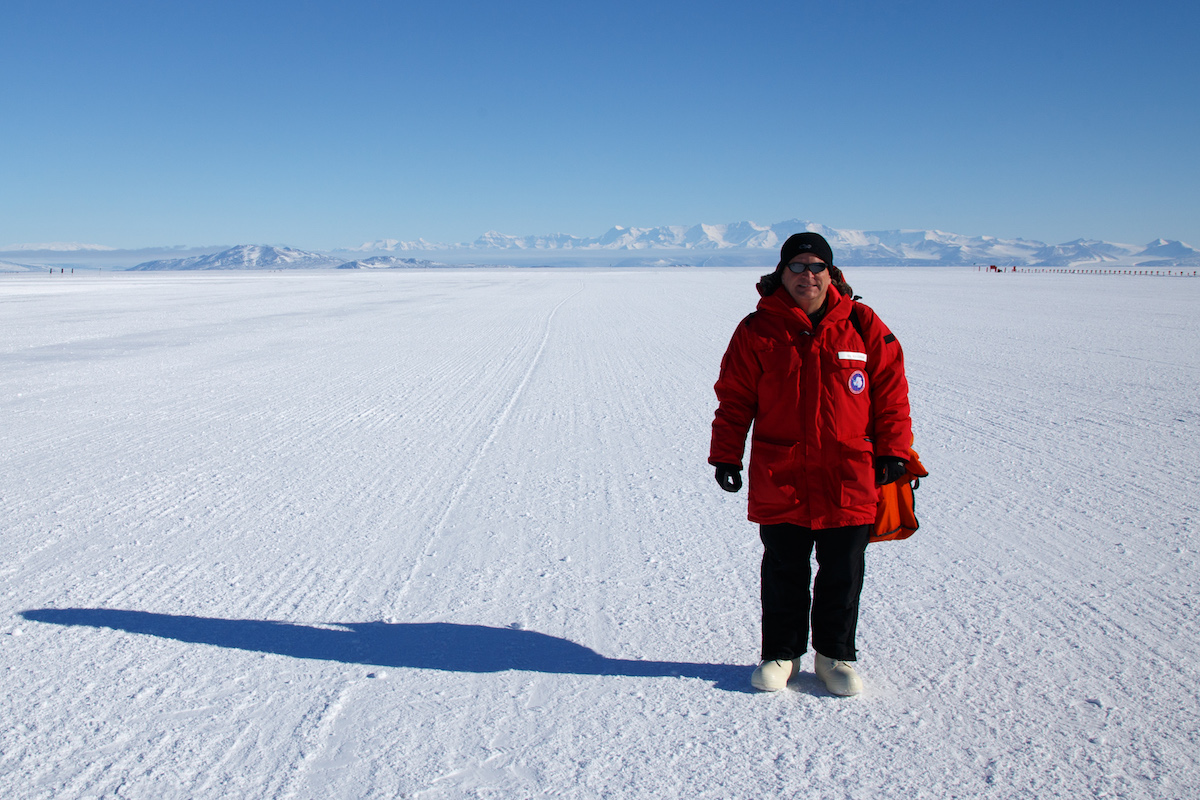
Walking off of the plane onto the Ross Ice Shelf is always one of the highlights for me of any trip. The Antarctic environment is so extreme and unique that it can always be a stunner. We were allowed about 5 minutes to take in the sights and then everybody loaded a large people mover vehicle. You can think of it as a trailer behind a large big-wheeled semi-truck. After getting into McMurdo we went to the arrival briefing. Much of this information is great for first timers, although they are likely overwhelmed with everything that is told to them. For others, it is mostly repetition from previous years. The significant information will start tomorrow morning with our science in-briefing where we meet with many of the supervisors of the personnel who will be supporting the project. Once we were done with the arrival briefing, we went over to the Crary Lab where most all of the project's activities in McMurdo will occur during the next four weeks. We found our office and lab space as well as got onto the internet, always a key initial step. Lastly, we made a quick visit to Science Cargo to learn the status of our cargo. We were able to find most all of the cargo. There are two crates still in Christchurch and we pleaded that at least one, if not both, are a priority to get into town as soon as possible.
Hero shot at the Phoenix Airfield immediately after getting off of the C-17. The first sites of Antarctica are always special. The mountains in the background are the Royal Society Range of the Transantarctic Mountains.
It has felt good to be back in McMurdo. Ever since my first trip to Antartica, McMurdo in some ways has felt like home to me. Yet each year is also different and there is turnover in the people that you work with every year. On top of that, you are taking your world, lifestyle, and daily patterns and acclimating them to a tremendously different environment and setting. I have moved into my room and I've been told that my roommate will be arriving tomorrow. I have decided to wait until then before getting fully settled into the dorm room. The reality is that I have only been here for six hours and if I am settled into my room, the lab, and life in town in five days, I am doing really, really well to start the field season. It is a slow process and the start of any field season is filled with briefings, training, meetings, and unpacking cargo. Sometimes, I have to remind myself to give it a little time.
Cargo being removed from the back of the C-17 aircraft at Phoenix Airfield. In the distance is Mount Erebus on Ross Island.

Monday, October 30, 2017

Southbound Flight

Hello, again! I have spent the last two days in Christchurch, New Zealand. As many of you know, that means I am on my way back to Antarctica. This will be my sixth trip overall and third trip in three years. I flew commercial from Denver to Christchurch with stops in Los Angeles and Auckland, New Zealand. That trip took approximately 25 hours from gate to gate, including a 13 hour flight from Los Angeles to Auckland. I left Colorado Thursday mid-afternoon and arrived into Christchurch around noon on Saturday. The lost day is due to crossing the International Dateline and I will regain that day when I return to Colorado. On Sunday morning I went to the Clothing Distribution Center to go through some initial training and to pickup, and verify fit, of the issued extreme cold weather gear. Our flight south to Antarctica was scheduled for today. However, early in this summer main body season there have been numerous delays. Included in those delays was the flight that was supposed to go on Friday. That flight did not go so that it went today (Monday), pushing our flight to tomorrow. I spent the extra day with a day trip to Akaroa, which is about two hours away from Christchurch. I have found that one extra day in Christchurch is often nice as it gives me a chance to reset and further prepare for the Antarctic field season.
Visiting Akaroa during my bonus day in New Zealand while waiting for the southbound flight to Antarctica.
Not only is it my third trip in three years but it is also the third project that I will be working on in Antarctica. Two years ago I did repairs, maintenance, and installation of automatic weather stations. That trip was done at about the same time as this trip, which is early to mid summer for the Southern Hemisphere. The project a year ago was flying a small unmanned aerial vehicle (UAV, aka: drone) to take measurements of the lowest 1500 feet of the atmosphere over successive flights in a 12 hour period. That trip was at the end of the winter through early spring (late August to early October). This year is a new project funded by the National Science Foundation with a goal of being able to measure precipitation using a collection of low-power instruments at remote locations in Antarctica. Precipitation has been an elusive measurement for the meteorology and climatology of the Antarctic. There are two primary reasons as to why this task has been so challenging. The first is that there is not a lot of snow that falls in the Antarctic. Antarctica is the driest continent. The second reason is that it is difficult to distinguish between blowing snow and falling (precipitating) snow in Antarctica. We can measure accumulation at a given location by putting a stake in the snow or by bouncing sound waves off of the surface to measure the changing snow height. The tricky part is determining what of that accumulation is due to precipitating snow. In a future post(s) I will explain why these measurements are significant and how we are planning to make these measurements of precipitation.

This year's project is also unique because it is the first National Science Foundation project where I am the lead. I have lead, or co-lead, previous field seasons but this time I am responsible for the overall project as well. One of the tasks I had to do is to design a sticker for the project. Stickers are a  really big deal in Antarctica as they both share a little something of what the project is doing, as well as provide something to give to the support personnel who play a big part in the success of the project. With the help of a friend, I was able to put together the design of the project sticker. The "O-456" is the project number and for many of the support workers that is how they identify the project.
The sticker for project O-456, the Antarctic Precipitation Project for 2017.
My southbound flight is scheduled for 10 hours from now. I have a 5:45 AM shuttle but pickup to take us to the Antarctic Passenger Terminal. That is where we will start the process of changing into cold weather gear and checking our baggage for the southbound flight. If all goes well, in 16 hours I will be walking on the snow of the Ross Ice Shelf at Phoenix Airfield.

Subscribe to receive future updates from Antarctica directly in your inbox.

* indicates required
Please indicate if you are a teacher.
Email Format

Wednesday, October 5, 2016

Home in Colorado

I am at the end of another journey to Antarctica, completing my fifth trip to the coldest, windiest, and driest continent. It is still hard to believe such trips have become sort of a regular occurrence as that is not what I set out to do, and I really don't ever want such experiences to be "regular". The travel off of Antarctica went exceptionally smooth, especially for Antarctic standards. We met at 1:00PM on Monday for transport to Pegasus Airfield on "Ivan the Terra Bus". You can think of Ivan as a monster-truck version of a school bus. It took about an hour to get to Pegasus as Ivan is much slower than a van. The C-17 arrived right on time at 2:20 PM. With 115+ people on the southbound flight, it took little effort to offload southbound and load northbound cargo. In fact, much of the C-17 was outfitted with seats that were now being filled with only 21 people. 30 minutes after the C-17 landed we walked to, and boarded, the plane. Another half hour later we were in the air going to Christchurch. It was a little over five hours to get to Christchurch and we were on the ground by 8:30 PM. Less than 8 hours from transport to Christchurch is really unheard of when it comes to northbound travel.

I spent about 36 hours in Christchurch before continuing my journey back to Colorado on commercial airlines. I requested a full day in Christchurch to provide an opportunity to rest, slow down, and acclimate back to non-Antarctic life. One of the post-ice trip highlights is a walk in the Christchurch Botanical Garden. It is always special to sense colors, sounds, and scents of nature that I've not experienced in over 5 weeks. I can't even imagine what that must be like for those who are in Antarctica for 8+ months. The time in Christchurch is also nice for getting some good food. After nearly seven weeks together, John and I finished off our journey with a great dinner. The travel back to Colorado was relatively smooth without any delays or drama and a total door to door travel time of about 24 hours.

It is still far too early for me to process and really put much of this past trip into perspective. That will happen in the coming weeks once I get a chance to slow down, as well as have conversations with family and friends. I have come up with a summary of some of the main storylines from the journey. These are not exhaustive, nor in any order, and I am probably missing some, but at this stage they present a good wrap-up to the season.

We were able to complete 33 flights over 10 days of flying the UAVs. This is a fraction of the number of flights that we had hoped to complete. However, the observations that we were able to capture represent a good range of atmospheric conditions and will provide a number of interesting cases to better understand the lowest part of the Antarctic atmosphere. The typical Antarctic field season is that you are fumbling around and facing setbacks and delays to start the season. Things come together for the last week or two and you come away feeling good about how the season ended. Our season was the reverse of that experience with the most productive and best field work at the onset. Yet in our case, this reverse operation was by far preferable because it was in those early weeks, when the transition from winter was the most pronounced, that provided the most interesting meteorological cases.

The entire trip turned on the night of the accident where the UAV hit John's hand and resulted in two deep cuts requiring stitches. In the days leading up to the accident, we were remarkably successful and completed nearly two-third of our flights in the initial week and a half. We had two days of five flights each. Things were never the same after the accident. We never flew more than three flights in a single day and we had some days where we sat at the passenger terminal for hours without getting in a single flight. The first UAV was totaled in two successive crashes on our first day out at Pegasus after the accident. In hindsight the UAV was likely damaged in the accident. After losing that plane, and the accident, we were more cautious and seemed to be continually fighting a lack of wind.

One of the events that sticks out to me is what I am calling "the 10 lost days" in the middle of the trip. These 10 days occurred between the accident and our presentation for the Sunday science lecture. (I talked about these days in more detail in a previous email/blog post.) Time seemed to stand still during those 10 days and yet after the 10 days were over it was a challenge to identify where all of that time went. It was also in those 10 days that I feel we transitioned from the "polar night" to the "polar day" as the sun was much higher in the sky, McMurdo was no longer in the shadow, and the temperatures were warmer. At the end of these 10 days I felt I got a better grasp of keeping track of the day to day activities. We still faced some setbacks after these 10 days but they did not feel like they were lost days.

Similar to previous trips, I had a fun time meeting many of the different friends and personalities in McMurdo. This was a different trip from the past in that we were two of only 10 scientists at the station during WinFly. That means nearly all of the 326 residents were contract workers with varying jobs from administrative to outdoor specialist to specific trades. There were some first years in the mix but most of the contract workers were people who have been doing it from two to 20 years. The last Saturday of my trip was highlightfed with the party held at the Carp (carpentry) Shop work center. The party is a tradition for the close of WinFly and it was a very fun night and a chance to spend time with new and old friends.

Those are some of the early storylines from this years trip. I will be sending out one more quick message in a week or two when I have posted all of the photos from the trip. Thanks again for following along on my journey to Antarctica. The next trip is scheduled for November 2017, although the details of that trip won't be determined until around March.

Sunday, October 2, 2016

Q&A - Answers

The southbound flight from Christchurch is in the air and I will soon be leaving for transport to Pegasus. I am never certain but it is looking likely that I will be leaving on my scheduled northbound day. I'll have more confidence once we leave the ground.

About two weeks ago I sent out an email asking for questions about Antarctica. I received a number of questions and I am finally getting around to answering them. Many of the questions came from the kindergarten / 1st grade students that I Skyped with last week.

Q: How often does McMurdo experience Condition 1 weather?
A: I asked one of the long-term contractors this question and he told me very rarely does it go to Condition 1 in McMurdo. It certainly varies from year to year but it seems that generally it is no more than a few times a year and sometimes never in a year. He said one of the key reasons for going Condition 1 in town is because people are essentially placed in lock down and it keeps everybody indoors and away from the dangerous flying debris due to the high winds. This friend has been in McMurdo for just over a year and he recently agreed to stay around for another month.

Q: Any fun friends?
A: The McMurdo community is an interesting bunch. There is a tremendous community and bond amongst the people here, especially those that come down year after year. This tight community will be especially evident in the coming week with people from all over the world converging back in a place that many of them now call home. Yet within that tight community, there are also some that never seem to come out from hiding. I was told that this year at the mid-winter dinner, with a static population of about 135 for most of the winter, there were people that arrived that looked like strangers. Getting to know the people of McMurdo and making new friends is always a highlight for me with my trips to Antarctica.

Q: What types of animals do you see during WinFly?
A: WinFly is not the time of the year to see animals. The sea ice edge and open water are a long distance away from McMurdo with it being at the end of winter.  That means that most wildlife, especially the penguins, are far away from McMurdo. On top of that, there are no helicopter or twin otter flights at this time of the year so there are no flights to where the penguins live, like I had a year ago. The only wildlife that is seen are Weddell seals. The Weddell seals are also not the most exciting animals to see as about all that you see is them lying around on the sea ice. There are scientists who have been down at WinFly, and more coming soon, who are here to study the Weddell seals.

Q: Are there blizzards there? If so, how do you know?
A: Yes, there are blizzards here and it is mostly driven by the strong winds that can be experienced in Antarctica. The strong winds in combination with the infinite supply of snow results in tremendous amount of blowing snow. Such conditions are especially true out on the sea ice, the ice shelf, and the ice sheets. The blizzards can be the result of a storm that is also precipitating (falling) snow or it can be a ground blizzard with blue skies above and only the result of the strong winds.

Q: Do animals get confused with no sun and then lots of sun?
A: Yeah, I have no idea on this question. You have to love kinder questions. I stumbled through this answer during the Skype session. Hopefully, they don't remember what it was that I said but you know that will not be the case.

Q: Do you drink a lot of hot chocolate?
A: Well, I am no fun with this answer because I have never been a hot drink person, of any type. I will say that drinking hot drinks in Antarctica is very common and often very wise as it is one of the few ways to warm your body from the inside. I have decided that I should find a hot drink that makes me happy for that very reason.

Thanks for all of the questions.

Coming to a Close

I am in what should be my final 18 hours in Antarctica. I say should because there is always an unknown when it comes to weather and Antarctic flights. I checked in my bags for transport this afternoon in a process referred to as "bag drag" and I am down to my carry-on bag. I have cleaned my dorm room and passed the housing inspection. The only remaining thing to do is to wait for the transport time when we are taken to Pegasus Airfield for our C-17 flight to Christchurch. I am estimating the transport time will be shortly after lunch.

In my last post, I shared about our long night of fighting the lack of winds and completing three flights in 15 hours. Those three flights ended up being our last flights of the field season. The following night we were both exhausted and the winds were once again light. On Friday, we went out to Pegasus for one last try. We arrived and the winds were marginal and the atmospheric conditions were less than ideal. After some thought, we agreed to not fight the light winds and end the flights for the season. We packed all of our gear and equipment from the passenger terminal and went back to McMurdo.

The remainder of Friday and Saturday were spent returning gear, packing cargo, and completing checkout procedures to finalize the field season. All of that didn't take too long and much of the time was spent either doing research for work back in Colorado, getting my things ready to go home, and spending time with friends in McMurdo. Saturday night was spent at a party held by one of the work centers. The party was a great sendoff for me, and more significantly many of the people who have been in McMurdo all winter and heading north for the first time in 6+ months.

McMurdo Station and the surrounding facilities are now looking more like main body season than the more dormant state that we saw a few weeks ago. It is clear the station is getting ready for the influx of people and science activities. The current population of 326 will double in the next week and it will reach a population of around 1000 for much of the season between mid-November to late January. Tomorrow's southbound C-17 flight is scheduled to have 114 people on the flight and there is another flight the following day with 99 more.

I am still working on, and struggling with, putting this field season into context. I am trying to sort through all of the experiences that I have been able to see and do. The early conversations that I have with friends and family, after returning to Colorado, will likely be a struggle in trying to explain the field season in a succinct and nicely organized story. I feel like I have not been able to capture so many of the dramatic changes and events that are associated with WinFly. Yet I also think we did a very good job in stopping and enjoying the moment whenever we saw something that interested us. My early conclusion is that you just can't see and capture it all. I'll be working on a better description.

Wednesday, September 28, 2016

Long Day / Night

I am at the end of a very long day, or night, depending on how you want to call it. We left McMurdo at around 1:30 PM yesterday afternoon. The plan was to do unmanned aerial vehicle (UAV) flights through the afternoon and evening. If things were going well we’d keep going into the night. We got back to McMurdo around 6:30 AM. During that entire time at Pegasus we were only able to get in three flights. We were fighting a lack of wind the entire rest of the time. There were two times where we loaded up the van and drove onto the runway. We got out of the van, verified the winds were good to launch, went back into the van to do the pre-flight checklist, and when we went outside to launch there was not enough wind. During the first time that it happened, we stood with our faces into the wind for five minutes, ready to launch, and waiting for the winds to increase. I even have video of those five boring minutes of us standing and waiting (we were hoping to make a video of the launch).  The second time, around midnight, we launched the UAV but it did not have enough lift. Fortunately, John was able to do a controlled landing and there was no damage done to the UAV. We didn’t get another shot at a launching the UAV until 5:00 AM. The data from the three flights will likely be interesting and useful, however, the more flights we have the better. By the time we were done with the third flight, we decided it was time to return to McMurdo. I also had an appointment to do a Skype session with kindergarten class at 8:00 AM.

The reality is that such a scenario, as we had during the last 24 hours, is the life of field work, especially in Antarctica. Instead of doing flights every two hours as we had hoped, we did a total of three in 15 hours (6 hours in between the first two and 9 hours in between the last two). This experience was also very representative of our last 2 1/2 weeks since the accident. It has been a continual battle in getting enough wind. During other years, there have been WinFly field seasons where the scientists and contract workers have continually battled too much wind. You never know what you are going to get and how it will impact your field work. The key is you have to roll with whatever comes your way, and hopefully keep your sanity in the process. The second part is the trickiest.

Being out at Pegasus all night also allowed me to experience and see just how much the conditions have changed since I arrived 4 1/2 weeks ago. The temperature at Pegasus Airfield was a few degrees above 0F overnight. That is in comparison to the -40sF that we were experiencing 2 1/2 weeks ago. The length of the day is now around 14 hours and the sky never went completely dark. In fact, at about 3:00 AM there was a little aurora australis in the sky but because the sky was not fully dark, the aurora was difficult to see. 

The first priority for today (Thursday) is to get some sleep. We might go back this evening or delay until tomorrow afternoon and into the evening. Either way, we have concluded that we have one more attempt to get in a series of UAV flights. Saturday is reserved for packing the cargo, returning equipment/supplies, and cleaning the lab. Sunday is an off day for most everybody in town and Monday is the day I am scheduled to fly north to Christchurch to end the season. This WinFly field season is coming to a close very quickly.

Monday, September 26, 2016

A Week in McMurdo

Life in McMurdo, or anywhere in Antarctica for that matter, can make the days all blur together and suddenly a week goes by where you are not sure how it was spent. Each day runs into the next and oftentimes one day does not distinguish itself from others. With the six day work week in town there is little time for the weekends to be unique. Part of the reason for days blending together is that there is a fairly small area where you live and what you see every day becomes very repetitive. I look back at the last two weeks and it feels like they have flown by and it is difficult to believe that I am down to one week until I leave McMurdo. This past Saturday I tried to think through my week and I was confused on what we did on several days. John and I had to pool our memories to determine which days we flew the UAVs, which days we went out to Pegasus and did not fly, and which days we never left town. I thought people might enjoy the results as a snapshot into the day to day life of a little over a week in McMurdo.

Saturday - September 17:  
We returned to flying the UAVs after the accident that cut John's hand. We went out to Pegasus in the morning after breakfast and promptly crashed the UAV (SUMO2) twice, rendering it no longer able to fly after the second attempt. We went back to McMurdo to get the backup plane and returned to Pegasus by mid-afternoon. We got in a couple flights, the winds turned light and variable, and we returned back to McMurdo by mid evening feeling happy with the two completed flights. (The UAV is difficult to launch with no wind to help provide lift at takeoff.) I was also happy to make it back to town to go to a "birthday blowout" party hosted by the plumbing shop.

Sunday - September 18:
We had thoughts of flying for the day but were hesitant because the forecast was for light winds. We agreed to meet at noon and evaluate our options. Sundays are the one day off during the week in town so the meals are condensed to a brunch and dinner. I had brunch, John and I met in the lab, and we were uncertain of the winds so we decided to wait and see how they would respond. We ended up staying in town the whole day. I remember going to the gym and getting in a treadmill run that afternoon.

Monday - September 19:
For this day we decided to do some flights ranging from early evening to the early morning hours. I spent the beginning of the day getting some research done for a project back in Colorado. We had an early dinner (right after the Galley opened at 5:00PM) and then drove out to Pegasus. We were able get in two flights and then the winds went to light and variable. We waited a couple hours and then ended the night early realizing we were not going to get in anymore flights.

Tuesday - September 20:
The plan for the day was to switch to more of a daytime schedule. We left McMurdo around mid-morning to do flights from mid-morning until around dinner. The first UAV flight crashed because of a bad throw and the winds were too light. We had to go back to McMurdo, without a successful flight, in order to repair the UAV. We made it back in time for lunch and spent the remainder of the day doing other work and I got in another treadmill run at the gym.

Wednesday - September 21:
We weren't sure of our plans for the day but the forecast was calling for it to be windy at Pegasus. The forecast verified and there was Condition 2 weather at Pegasus, which meant it was too windy and too low of visibility at Pegasus to do any UAV flying. We spent the day in McMurdo getting other work done. I was able to get in my longest treadmill run of the season late that evening.

Thursday - September 22:
John had a Skype session in the morning with his daughter's elementary class. With that commitment we planned to do early afternoon to evening flights at Pegasus. We started to leave at 1:30 but did not get very far. We brought in our van to the vehicle maintenance facility to have the fluids topped off. They took care of the fluids and then decommissioned the van because it was leaking too much power steering fluid. It was not until 3:30 that we got a replacement van and were able to leave for Pegasus. The van problem was not much of a delay because we got to Pegasus and the winds were too light to fly. We waited at Pegasus for about four hours and determined the wind was not going to be increasing anytime soon. We decided to end the day and returned to McMurdo without any flights.

Friday - September 23:
Friday had a significant storm that was very well forecast. The storm verified with Condition 2 in McMurdo and Condition 1 at Pegasus Airfield. The weather stayed about the same the entire day. After a run of a few days of pushing the pace and getting nowhere, I decided to slow down and take it easy the first half of the day. I was able to do my laundry that morning. That evening I made it to Gallagher's (the one bar open during the winter) where it was Open Mic night. I was able to see some fantastic performances by some of the workers in McMurdo.

Saturday - September 24:
We decided to stick with the plan for flights from early afternoon through the evening hours. That allowed me to do another treadmill run in the morning. We left for Pegasus at noon and were treated with some near ideal winds to fly the UAV. We completed two flights back-to-back (we generally do flights every two hours). The winds were too light to fly when we wanted to do the third flight. We tried again an hour later with no change. We waited another hour and found the winds acceptable and completed a third flight. After the third flight, we concluded that the winds were likely going to be light for the rest of the night, we were happy to get in three good flights, and we decided it was best to return to McMurdo. We were back in McMurdo by mid-evening.

Sunday - September 25:
The forecast was for light winds throughout the day. We also had the weekly general science lecture in the evening. It was a rare day where we left the lab the night before with no plans to fly for the day. We also had daylight savings go into effect overnight. (While there is no need for daylight savings in Antarctica, McMurdo Station, South Pole, and most of the US Antarctic Program follows the time of Christchurch, New Zealand which switched to daylight savings.) I went to the non-denominational church service at the Chapel of the Snows and then the weekly brunch. Most of the afternoon was fairly quiet until late afternoon when I took some time to prepare for my portion of the science lecture. The evening was dinner and the science lecture, which went well.

By the end of the week I was able to remember that we had a couple days with a couple flights, a couple days with no flights due to no wind, and a couple days with no flights due to a storm. The difficult part was putting the days in order because it all seemed to blend together.